
1.0 INTRODUCTION
Breadfruit is one of the multi-purpose and traditionally important trees in the Pacific, and has long been an important staple crop and an integral part of agroforestry systems the people have practiced. Like other Pacific Island nations, breadfruit tree is significant as a source of food in Solomon Islands, particularly mostly valued by the people of the Temotu province. This was evidenced from an outcome of a national survey conducted in 2000, whereby people in Temotu province prioritized breadfruit over ngali nut (Canarium spp.) as number one crop. The other provinces prioritized ngali nut as their number one crop.
Furthermore, as a unique traditional practice, the people from the Temotu province processed Valued Added Product (VAP) called Nambo from roasted fruits over open fire, left it cool overnight, then sliced the fruits into triangular cubes and dried them under smoked hot-air dryer fueled by firewood.
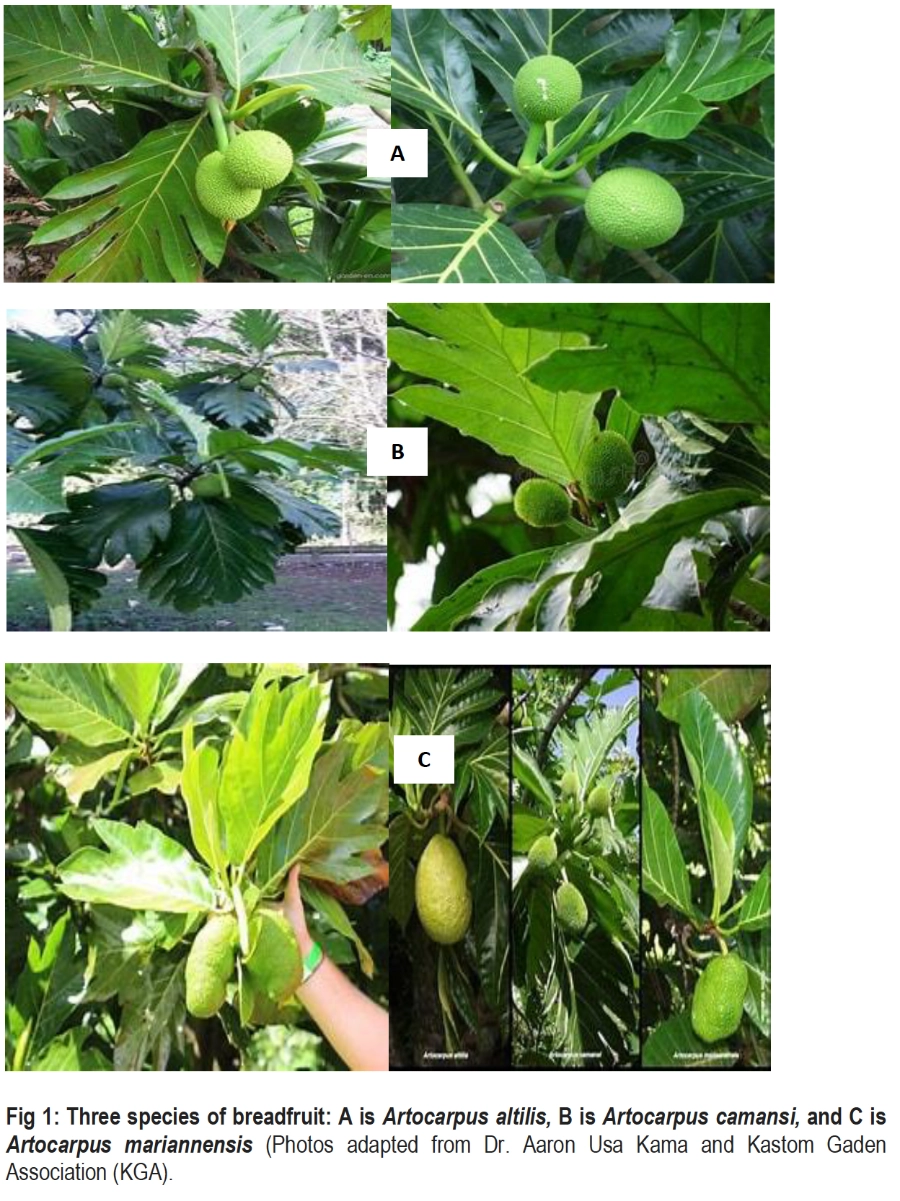
There are three species of breadfruit present in Solomon Islands – these are; Artocarpus camansi, Artocarpus mariannensis, and Artocarpus altilis (Fig 1). The trees can grow to heights of 15 to 20m or more, and has trunks as large as 2m at base diameter at full maturity. The origin of breadfruit is thought to be in the Pacific, although the wild form of breadfruit (A. camansi) is native to New Guinea and Moluccas (Indonesia) and Philippines (Diane Ragone, 2006). Ragone (2006) reported that the first domestication of breadfruit in the western Pacific region occurred some 3,000 years ago.
Breadfruit is known by different names in the Pacific, for example, beta in Vanuatu, kapiak in PNG, meduu in Palau, kuru in Cook Islands, and uto / buco in Fiji, ulu in Hawaii, Samoa and Tuvalu, and mei / mai in FSM, Tonga, Kiribati, Marshalls and Marquesas. In Solomon Islands it is called bia / nimbalu (Temotu province), barego / bario (Choiseul province), (Isabel province), (Western province), (Malaita province), and (Guadalcanal province).
2.0 PURPOSE
This booklet is produced to document traditional knowledge on different varieties of breadfruit in Solomon Islands. Moreover, the booklet is a benchmark for future work on breadfruit and its findings – to add new knowledge and improve understanding on different perspectives and aspects of breadfruit in Solomon Islands.
3.0 APPROACH AND METHODOLOGY
Participatory approach whereby people are involved in the discussion and decision-making process was applied to obtain relevant information based on indigenous knowledge and traditional perspectives. Two methods – i) Personal interview and ii) Focus Group Discussions (FGD) were used to engage people for discussions of key questions to generate information.
Twelve villages in Temotu province, and five villages in Western province and, four communities in Honiara City have participated in the project.
4.0 PROFILE OF BREADFRUIT VARIETIES
4.1 BACKGROUND
There are hundreds of known varieties of breadfruit in the Pacific, in which the span of their distribution varies across the region. This booklet documents some named varieties of breadfruit cultivated in Solomon Islands, especially in the Western and Temotu provinces. The varieties have been identified based on traditional knowledge provided by the people who have been consulted and participated in the oral interview as individuals, as well as through conducting FGD. Where possible a field visit was also conducted to visibly identify and photograph the trees and their fruits.
The following attributes of the breadfruit have been examined and affirmed as unique to a named variety.
- Size of tree (estimated height)
- Fruit size, shape and surface
- Flesh color
- Seed or Seedless
- Fruit bearing
- Yield
- Season
- Best use
Where possible, the named variety was photographed, and fruits were characterized to determine tree-to-tree phenotypic variation (see Breadfruit Characterization booklet).
4.2 BREADFRUIT VARIETIES FROM WESTERN PROVINCE
Download the document to find out more about the 85 Breadfruit varieties from the Western Province.
5.0 INFORMATION GAPS AND CHALLENGES
The successful gathering of indigenous knowledge based information about breadfruit varieties is evidenced in the production of this booklet. However, it is imperative to acknowledge that there is room for improvements, especially in closing information gaps and addressing the challenges that have been experienced.
Owing to the fact that the varieties have much similarities in the assessed phenotypic traits, especially in the description of fruit size, shape, and surface, and flesh color, the identification of a variety is a very challenging task. Hence, the need to conduct further assessment to determine varietal variation is deemed necessary. Further study is being recommended to include; i) organoleptic characterisation of fruits, and ii) molecular study of variation.
In organoleptic fruit characterisation, the selection of taste, such as sweetness, acidity, odour, sourness, oiliness, etc. is determined, and can help to identify one variety from another. Furthermore, it can expand the traits included in ideotype, and can perhaps be related to other traits such as protein, fibre and carbohydrate content of the fruits of a particular variety. On the contrary, the molecular techniques will generate data that underpin the understanding of the genetic variation in variety, species and population. The study should reveal specific genetic information about genetic diversity and the relatedness of individuals and genealogical relationships with morphological traits.
6.0 CONCLUSIONS
This booklet is the first of its kind, and it documents more than 80 varieties of breadfruit cultivated in Solomon Islands, especially in the Western and Temotu provinces. There is much similarities than differences between these varieties, and this makes correct identification of varieties a challenging task, especially if you are not a local of the area or unfamiliar with breadfruit.
Further work is recommended to expand knowledge and create a better understanding of these varieties. Moreover, such work should establish a genetic pool of information for conservation and the future enhancement of breadfruit commercialisation in Solomon Islands.